
 Bachelor Life
If you’re living the bachelor life, you got to do it right and using legit dating sites to find your future dates is a great way to start. If you’re a successful, handsome man you have probably gotten used to living the bachelor life for quite some time now. Especially since the invention of online dating become accessible to anyone with a cell phone. Using adult sex websites to hookup with hot singles is probably the easiest way to get laid. But if you’re a successful bachelor, you probably don’t need to spend all your time online. Having a good job, a nice car, and being well put together will make a lot of women want to sleep with you.
A lot of women are attracted to the way a man smells. This has been proven on many different occasions, and some women can even relive a past relationship just by smelling a familiar cologne. If you’re a bachelor who loves to sleep with many different beautiful women, you might want to start thinking about finding your trademark smell. Having a trademark smell will make women want you more, and it will leave them in want whenever they smell it. Finding your trademark smell can be tricky, but when you finally master it, it will be worthwhile. If you spend the night at someone’s house, you will leave your trademark smell on their pillow, and they will remember you for as long as it lasts.
When a woman goes on a date with a man, she expects them to have good hygiene skills and look somewhat presentable. When you agree to go on a first date with someone, you need to leave an everlasting first impression of yourself. Wearing cologne can definitely make a woman feel more attracted to you, and make your first impression surpass anyone else’s. Wearing cologne can give off a great first impression, and this is because women are always surprised to come across a well groomed man who takes pride in his appearance. When you wear cologne, you are basically telling a woman that you care how you smell, which believe it or not, is a big turn on. Women are very sensitive when it comes to smells, and so if you show up to your date smelling like body odour and armpit sweat, you can bet all your money that your date will never agree to go out with you again, or even answer you all together. A nice smelling man is what women want, so if you want to create an everlasting first impression, wear some cologne to your date.
This may sound weird, but if you show up to your date looking fresh and smelling amazing, your date will be instantly turned on. Women want to date a man, and men wear cologne, so if you want to get laid on your first date, make sure to be visually appealing to your date. Put on some cologne, wear clean clothing, and run a comb through your hair and you will become a sight for sore eyes. If you want to arouse your date, you need to look and smell the part, if not you’ll have to find other ways to arouse your date. If you want to get laid, the best thing you can do is arouse her from the very beginning, and the only way to do this is to show up looking sharp, and smelling amazing.
According to many different women, the best cologne is one that is subtle, sweet and manly. The number one best cologne (according to women) is Yves Saint Laurent La Nuit De L’Homme. This cologne is apparently to die for, and many women have stated that they are immediately attracted to men who wear this cologne. Another women-favorite is Paco Rabanne’s 1 Million, this smell has been described as unmistakably manly and delicious. In third place, is a Versace’s Eros, this smell goes with many different occasions and can drive any woman wild. With so many different colognes out there, it can be hard to figure out which ones are the most popular, luckily women are not afraid to voice their opinions. In fourth place, is Jean Paul Gaultier’s Le Male, this smell has been a timeless favorite for many different women, it is a trademark bad boy smell and has been known to get men laid.
 Relationship Problems
Finding out that your partner is using an adult hookup site to cheat on you might as well be the worst news in the world. Not only are they choosing to stay in a relationship, but they are choosing to cheat on the person they are supposed to love. Coming face to face with the facts can be very difficult to accept, but when the facts are all there, you need to accept that your partner is subscribed to adult hookup sites with the hopes of cheating on you. When you confront your partner, they might immediately be overcome with grief, and swear to you that they have never met up with anyone. Your partner might confess to using adult hookup sites to chat with horny singles and nothing more. If you believe them, and want to learn how to fix your relationship, you can always give couples counseling a try.
Is couples counseling for you? Well it is if you feel like you need some help getting through a relationship problem. Couples counseling is for serious couples who want to fix their problems at any cost. It can also really help couples who are suffering from anger management issues. If you and your partner need to address some issues, but end up fighting every time you do, going to couples counseling might just be a fantastic idea. Your couples counselor will help you say what you’re thinking, and you will leave your appointment with a light mind and heavy heart. Couples counseling certainly isn’t for every couple, but it can definitely help a different variety of couples overcome some hard times. If the most important thing in your life is to save your relationship and stay with your partner, couples counseling is definitely for you. If saving your relationship sounds stupid, boring, and useless, it is probably time to break up with your partner and start looking for someone new. In the end, couples counseling is for anyone who wants to save their relationship.
Every relationship has problems, but some have more than others. Depending on your lover’s characteristics, overcoming relationship problems might seem impossible. If your partner is unreasonable, difficult, verbally abusive, and just plain angry, you might need some help solving your relationship problems. When a couple is comes together to solve a problem, only good things can happen, but sometimes angry people are unable to solve problems because of their strong emotions. They may feel victimized, confused and insulted that their partner wants to get help from a couples counselor. Angry people usually have a lot of pride, and so if you’re dating someone who has anger management issues, seeking the help of a professional can really help you solve your relationship problems.
A good relationship starts and ends in the bedroom. If you are in a relationship with someone who never wants to have sex with you, you might want to start asking yourself some difficult questions. If your sex life in nonexistent, something is definitely wrong with the way things are going. For a relationship to be healthy, you need to be having regular sex and sharing intimate moments with your partner, once you stop doing this, you might start feeling stuck in your relationship. A lively sex life will make you and your partner feel more in love with each other, while neglecting your sex life will make you resent each other. If you and your partner have stopped having sex, you need to ask yourself you’re still in love, attracted, and devoted to your partner.
Couples counseling can be very expensive, and so if you are thinking about paying for a professional for relationship advice, you better be sure that your relationship is worth it. If you want to make sure that your relationship is worth saving before enrolling yourself in therapy sessions, find out how your partner feels about it first. If your partner doesn’t want anything to do with couples counseling and laughs at the idea, see it as a sign. If your partner is unwilling to change, or even make the smallest of modifications, see it as a sign. But most important of all, close your eyes and visualize what you want your future to look like. Are they in it? If you can easily formulate a future with a different partner, see it as a sign.
 Girls Hooking Up
As most of us know, when girls hook up with a guy on online dating platforms, they tend to be a little ruthless. We’ve all had to go through a breakup at some point in our lives, and although it is usually for the better, it can seem a little insurmountable at first. When girls start hooking up with men online, they can be a little overwhelmed by their options. This is because when a girl signs up for an adult dating website, most men will end up messaging her to see how high their chances are. These girls will receive an insane amount of messages, which will make them feel more entitled to keep hooking up. Can we really blame someone for dumping us when they have so many other options and have made it clear that it was only a casual fling in the first place? No, we can’t. Sure, girls hooking up can be a little wild, but in the end, who are we to judge?
There are many different ways to dump someone gracefully. However, there are no easy ways. Making the decision to end a relationship is very difficult, but in the end it can be exactly what you need to start growing as a person. If you want to dump your partner, but don’t want to do it in an insulting way, then you need to learn how to dump someone gracefully. The most important part of breaking up with someone is giving them a reason for the breakup. You can’t simply say that it’s over and then disappear. In order to properly dump someone, you need to have reasons, but not insulting ones.
If the time has come to end your relationship, you need to make sure end it compationalety and thoughtfully. Sending someone a text message and telling them that you can’t see them anymore is one of the worst things to do. Sure, it’s the easiest way to get your point across but it will probably come back to bite you in the butt. To break up with someone properly, you need to think about doing it in person. By breaking up in person, you are showing them that you respect them and want to make sure they are alright. When breaking up with someone in person, you will be able to answer their questions, console them, and let them know you still care but don’t feel like you once did. If you’ve been dating someone for a long time, and then break up with them by text, they will probably end up banging on your door the same night.
Once you have broken up with you partner, you will be able to start working on yourself. A good thing about breaking up in person, is that you’ll have the chance to tell them that you need space and are thinking about cutting off all contact until you’ve both had enough time to think things over. By cutting off all contact, you will give your ex lover the chance to heal and get over you once and for all. After a couple months of no contact, you can always message them to see how things are going, and have a nice conversation with no hard feelings involved. By dumping someone gracefully, you give yourself the chance to remain on good terms with them, opposed to making a brand new enemy who will spread lies about you and give you a bad reputation. If you break up in person, give them significant reason, talk about how you feel, apologize and thank them for everything, and then ask to cut off contact in order to move on, they will probably heal a lot faster and respect your decision.
The number one rule to breaking up with someone gracefully is not making a scene. If you know that your partner has the tendency to raise their voice when angry, you might need to pick a proper setting to stop them from causing a fuss. Don’t break up with your lover in a cafe, shopping mall, or any public place really. To stop them from making a scene and drawing in unwanted attention, you can always dump them in their home or in a park. Another easy way to stop them from making a scene is to just drive to their place, ask them to get into your car, and then break up with them in there.
 Get Laid With SexFinder.com
You might have heard of SexFinder.com by word of mouth or via internet. If you haven’t, then allow us to introduce you to one of the best hookup websites out there. You might be asking yourself if SexFinder.com is any good, and the answer is yes, it’s fantastic. SexFinder.com is an adult dating website that allows you to chat and meet up with the most awesome singles around. SexFinder.com has become extremely popular in Vancouver, and has been pairing up handome men and gorgeous women together for quite some time now. At SexFinder.com, we have scoped out all the local talent for you, so all you have to do is make yourself a profile and start chatting up with local, hot singles from around your area.
At SexFinder.com, our main priority is getting you laid via an internet adult dating sites. We have put together easy search engines and gone to extreme lengths to get our clientele the type of hookups they deserve. If you want to get laid using SexFinder.com, then you are in luck because that is exactly what are website is made for. SexFinder.com is an easy and sure way to get local men and woman around the Vancouver area to meet up and have sex. Getting laid has never been so easy! If it’s been awhile since you’ve had sex, you might just be in need of our services. Get laid using SexFinder.com and see for yourself!
Winning an argument might not sound like the most important thing, but it can sometimes be necessary. In order for you to win an argument every single time, you need to make sure that you’re always right. If you know you are right, then you should have no problem at winning an argument. If you have gotten into an argument with someone at work, in the service industry, or even on SexFinder.com, you need to know how to come out on top. To win an argument, you need to have valid points and proof backing your statements up. Without proof you will just look like a liar and lose the argument. By taking pictures of conversations and keeping even the smallest details on record, you will be able to prove your adversary wrong if need be. Also, by keeping calm and talking in an educated manner, you can easily win an argument without breaking into a sweat.
Much like every other local dating website, you need to be smart about who you talk to. At SexFinder.com, we try our hardest to eliminate every type of threat, but as you must know scammers will usually find their loopholes. When using SexFinder.com to hook up with beautiful women or sexy men, we suggest that you do not give out any personal information via the internet. A popular scam that we have seen before, is the one of super hot women messaging men and sending them provocative pictures. When the man responds, and asks to see more, these ‘women’ ask for their credit card information. This is a pretty obvious scam, but we just felt the need to cover all of our bases. If you do receive a message like this, feel free to report it, in fact it’s encouraged.
At SexFinder.com, we want you to have the opportunity to get laid. If you happen to be in Vancouver, then you will notice that there are a high volume of gorgeous women looking for casual hookups. The one tip we have for you, is to make sure your online dating profile is inviting, cool, and easy to read. Stumbling on someones profile and seeing that they wrote 5 paragraphs under their profile, is a turnoff for most women. So if you want to get laid, and we’re sure you do, then make sure to keep it simple. Also, put up some attractive pictures of yourself on your online dating profile. This will double your chances of getting laid. Your online dating profile is the first thing anyone will see, so make sure it is outstanding. If someone does not like your pictures or you online dating profile, they will simply click next and you will be forgotten. Don’t let this happen, and certainly don’t put yourself in the position to miss out of some good online hookups. Trust us when we say that your online dating profile is the first step in getting you laid.
While the internet and mobile apps have opened a whole new world for dating possibilities, it has not necessarily made it easier to meet local singles. With all of these new online platforms there are also new challenges and difficulties to overcome. Where you are looking for a long term romantic relationship or a casual hook up, if you want to be successful it is important to know the intricacies of the online dating world.
Different platforms or online dating services have different clients, so you have to know which one is right for you, and how to interact on each platform in order to be successful on your quest for love and romance. This isn’t always an easy task as internet dating services and mobile apps are constantly evolving to meet the needs of the ever changing online dating demographic. Do your research beforehand and know what you’re getting involved with. As a general rule to help you meet local singles, online dating sites typically have more versatility and extensive profiles than mobile apps, which means that you are more likely to connect with serious users.
 How to Date Online
Online dating is a way of streamlining the process. It allows people to meet who never would have had the chance before. While this is one of the benefits, the use of the internet also increases the amount of options for daters, making it hard for even the most eligible of bachelors. To be noticed amongst the swarm of possibilities, you have to stand out. Use your photos to showcase what makes you special and be creative with your words. For example, you could have a short story describing one of your photos, or don’t just say you like something, explain why you like it. The taboo of online dating is gone, so don’t be afraid to ask a friend from the same sex that you are trying to attract to look over your profile. Ask for input on what they would be looking for and what they thought when they saw your profile.
Remember the saying that a picture is worth a thousand words? Well, it couldn’t be more true for online dating. Right around 90% of online matches happen because of the photos. Don’t mistake online daters as being shallow, instead remember that those photos not only showcase your looks, but also your interests and personality. In this fast paced online dating world, it’s important to quickly showcase who you are, so pick photos that not only make you look physically attractive, but also interesting and social. The photos you choose operate as a snapshot into who you really are. Take a second to reflect on what a profile with only selfies suggests.
While you want to stand out and be different, it is important to make sure that you are actually showcasing you. No matter what you are looking for, a one night casual hookup or a romantic partner, to be successful you don’t want to disappoint the people you are meeting. Whether it is in the photos or the descriptions, you want their first impression in person to match your online dating profile. For a long term romantic partner, being honest with your interests and lifestyle is very important. One of the fundamental benefits of online dating is that it can easily connect you with people who have shared interests. Neither of you will be happy if you end up hiking every weekend just because you thought it made you more interesting.
Just because you matched with someone doesn’t mean that you are in the clear. You made it past the initial test, but now you need to prove that you are truly worth their time. The first few messages can be the most important part, so if you want to be successful steer clear of anything cheesy or self-indulgent. For any fast paced dating option, do not wait after you have been matched, say something right away. Ask them a funny question, but stay away from anything offensive or boring. While a clever or funny comment is preferred, it is not always necessary. Especially on more traditional internet dating sites, simply asking how they are doing, followed by a question relating to their profile is often the most honest and simple way of starting a conversation. In either situation, taking this approach will almost always guarantee a response from someone who is actually interested and actively pursuing a romantic relationship or a casual hook up.
Many of us fantasize about having an affair, but quite often it can seem like a risk that is not worth the fun. Although you may be in a relationship that doesn’t quite satisfy you in the bedroom, you may consider that it is not worth the trouble or potential disaster with your partner, just to get a little bit of casual sex on the side. If you feel this way that is totally understandable and it is an honorable choice, but for me and many other people, sometimes the risk does seem to be worth it for a few discreet sexual encounters. That being said, I would never suggest running into something that could come back to bite you. You have to make sure that you don’t get caught cheating, and if this means that your adult affairs need to be secret, then so be it. Even with the best online dating services, you still need to know how to lie about your adult affairs, and keep everyone happy. This requires a gentle step and a bit of tact when it comes to finding casual sex that won’t ruin your relationship.
 Keep it Cool
If you want to successfully lie about your adult affairs, then you need to keep your emotions at bay. If you get too worked up about your casual sex hook ups, then it is likely this will start to show if you are ever questioned or confronted about it. The best thing to keep in mind so that you don’t get caught cheating is that you need to know where your loyalty lies. Although you may be giving the poke to a woman on the side, you still need to honor and respect your long term relationship by knowing where you are going at the end of the day. This will help keep your partner at home happy, and will help you avoid getting wrapped up in a sticky situation. When things are casual during discreet sexual encounters, your adult affairs will be much more relaxed and enjoyable. Recognize things for what they are, and just work on having a bit of fun, instead of building a new relationship behind your partner’s back.
If you want to make sure that you don’t get caught cheating during your casual sex hook ups, then you need to make sure that you are using a decent online dating service. Bogus sites are a total waste of time and can actually put your adult affairs at risk of exposure. Not only do bogus sites barely work for getting a real date, but they can also put you at risk of scams or even worse. I have used a bunch of dating sites, and unfortunately the majority of them can be pretty terrible for finding casual sex. I have found dating sites like Justhookup.com to be a money pit that leads no where, and I have spent countless frustrating hours trying to navigate sites like that. If you want to see more about why it doesn’t work, check out this review of a useless dating site, and read more about other people’s opinions on what works and what doesn’t work. Using one of the best online dating services can make a big difference for keeping your adult affairs secret, so make sure to do your research before so that you can avoid a hookup site that could potentially get you caught while cheating.
One of the biggest mistakes that guys can make when cheating, it to rush into a situation without thinking about the consequences. If you want to lie successfully about your casual sex, then you need to make sure that you are not entering a scenario that could potentially raise a lot of questions with your partner back at home. Don’t get caught cheating just because you said you would be home at 6 pm, but then arrive hours late stinking of another woman’s perfume. This is not going to go over well, and will definitely look suspicious. Instead, take your time and arrange casual sex for times that are appropriate and when you are less likely to get caught in the act. Perhaps this means that you will have less discreet sexual encounters, but they will be much less risky and you will probably be able to prolong the experience. If your wife is gone for the weekend, and you get a little action in while she is away, she probably won’t even notice what has happened.
 Dating Tips for Women
Dating tips for men often suggest to always be yourself and the same is true for women. In fact, many of the best dating tips for men are something women should know because they can use it too. Older women can further their dating knowledge by exploring different dating tips for men over 40 to find advice more targeted for their age group. Remember that no matter what other tips you utilize when you are dating, nothing will beat being yourself. It is important to remember this and always keep it in the back of your mind because it is easy to get lost in a situation and act differently than you normally do.
When you look at the best dating tips for men, you will find that it puts focus on being confident. This is because women appreciate confidence, but so do men. Remember that you will not be able to boost your confidence overnight, so give yourself some time. Get out more with friends, fix things in your life that make you feel uneasy and make note of the things in your life that are going great. Remember that confidence is a mindset and a mindset is something that you can change with the right amount of time and the right tools at your disposal.
Get some male dating tips from the men in your life that you trust. This will help you to better understand what men are looking for so that you can consider the types of men you are most interested in dating. Ask them about the things they enjoy when they are on a first date and the things they enjoy discussing. You can use this information to make yourself more comfortable when you head out on your first date with a new special someone.
When you read about dating tips, they often focus on what you can do to get more dates, but it is important to not forget about the things you want too. Never compromise your morals or the traits that you find most attractive just for the sake of a date. Being picky is perfectly fine and you have to allow yourself to be. This is especially important if you are looking for a long-term relationship because you want to make sure that you are focusing on men that have this potential with you.
You want to get him interested in your personality from the first time the two of you talk. This goes back to being confident and making sure to be yourself at all times. Whether you are talking online or on the phone, or you are on a date in New Plymouth, New Zealand, you want to put your personality front and center. Men all have certain personality traits that they prefer and when you expose them to your full personality right from the beginning, you will be able to tell if he is truly interested so that you do not waste your time with men where no relationship is possible.

Things can get spicy even you are disabled
It’s not that easy to get around when you’re disabled physically. Maybe you’re in a wheelchair, or maybe you’re just temporarily on crutches. Whatever the case, you should bear in mind that there’s always a way to still have fun, especially on hookups when you’d least expect it. You don’t have to stop having those no strings flings that you really enjoy just because you’re in a wheelchair, and if anything, it can actually add another element to your hookups that you’d never expect. There are a lot of fun ways to actually make your disability a lot of fun, so you might as well stay comfortable in your own skin, and not worry about whether or not that wheelchair makes your life difficult in the bedroom.

You can still enjoy a power-play
This isn’t for everyone, but there’s definitely something to be said about the power-play dynamics that you can mess around with when you’re on a no strings fling and also in a wheelchair. Considering you’re not going to be able to run laps around Saskatoon, there’s a good chance that you’re hookup is going to have to do a lot of the work for you, and there’s no reason why the two of you can’t play that up in a way that’s actually pretty damn sexy. There are a lot of simple BDSM scenes that can very easily be brought into the bedroom like this. If your partner is already into waiting on your hand and foot, there’s no reason why they can’t take it to the next level with BDSM. Of course, the two of you should always discuss any sort of Dom/sub relationship–no matter how temporary–at length before you dive right into it. This will make the two of you have a much more fulfilling hookup, and you’ll have a lot more fun being able to boss her around from your wheelchair, which, honestly, might as well be your throne for the evening. There are a lot of different ways you can work this kind of situation, but if you’re the Dom, it will probably be easier. Being able to order your sub around while they wait on you and generally pleasure you in whatever way you want the hookup to go will be enjoyable for both of you, and hopefully, you’ll find out that being in a wheelchair really isn’t the kind of thing that you need to think will hinder you sexually in the future.

Let her ride you if your leg is broken
Maybe your disability is a temporary thing, and that’s fine. You can still work it in the bedroom and have a lot of fun while you’re doing it. If you’re on crutches while you’re having your hookups in Saskatoon, for example, you can still have a lot of fun in the bedroom. Limited mobility doesn’t mean that you have to be hindered in any real way; it’s just going to take some finagling in order to make it all work out in the end. One of the easiest ways to make this part of your no strings fling work is to simply let her do a lot of the work when it comes to penetrative sex. If you have a broken leg, obviously you’re not going to be the most mobile or have the easiest time when it comes to banging her into next week. There are several different positions you can try instead, and a lot of times, just having her on top is the simplest answer. She can ride you while you enjoy yourself underneath her, and maybe play with her breasts or otherwise touch her wherever she wants it. This can be done in bed, in a chair, or wherever the two of you are most comfortable.Oral sex is also something that you shouldn’t count out. She can either be giving it to you, or you can be giving it to her. There are many different positions the two of you can try out that aren’t going to involve you doing a lot of maneuvering, and that’s always important if you’re just having some mobility issues. Your disability–no matter how permanent or temporary–obviously has no bearing on how much fun you can have in the bedroom when you have options like these available. It’s definitely all what you end up making of it.

Spice things up with some metal bondage
If you’re already a little immobile then bondage is probably something that has occurred to you in order to spice things up a bit. Having your partner string you up adds an eroticism to something that has probably become a mundane fact of life, and that’s what hookups are supposed to be–spice to your life that you really, sorely need. As with any form of bondage or consent play, there’s the fact that you need to chat about safe words beforehand. Once that is the out of the way, however, you can have some fun either being strung up, or if you’re at least somewhat mobile, you can string your partner up in interesting ways as well. There are other forms of bondage that involve chastity devices that they can actually wear that aren’t going to impede their mobility, but give you a greater deal of control when it comes to making sure they actually orgasm or not. There are several different kinds of bondage that can be brought into the bedroom, and especially on hookups, the two of you can go wild and discuss what you think would work best for both of you, your situation, and of course, whatever disability that you’re dealing with at the same time.
At the end of the day, there’s honestly nothing better than a vibrator. It simply makes everything easier for everyone, and we’ve never really met a girl that wasn’t interested in being teased with one in at least one way. That’s why we highly suggest that you have at least one vibrator in your hookup arsenal. They’re especially useful if you’re one with limited mobility, because you can always ask your partner to pleasure herself while you watch. This kind of mutual masturbation can be an extremely erotic thing on a hookup, and you can masturbate yourself while she does the same with the vibrator…or with any other sex toy that she wants to use at the time. You can also incorporate dirty talk into the scene, or any other fantasy that the two of you want to act out at the time. The sky’s the limit with this one, and that’s why you should just let your imagination run wild and give you every opportunity to have fun in the bedroom.
Dating is always going to be local. Though the sites you sign up for could have people from all over the country, all over the world even, you are only going to be interested in the girls in your state, city, or even neighborhood. To do this, you have two options. Signing up for a hyper-local site, or using a local newspaper is one option, but this is limited. The other option is to use the bigger sites and use their extensive search tools to narrow down your search to only the local girls for you.
When you start searching for online dating sites then start by just looking for dating sites that focus on your part of the country. These do exist. If you live in Las Vegas, for instance, you can definitely find local dating sites, either as stand-alone sites just like any other dating site, or as part of some other local site, such as a newspaper. Local newspapers are obviously good places to start your dating adventure if you are looking to post locally, and often these sites are the top local classifieds websites.
Of course, the best top local classifieds websites for you are going to depend entirely on where you actually live. However, I can give you are quick rundown of a few sites that I like and that either have specific forums for different parts of the country, or have such extensive coverage and great search functions that they almost act as the best top local classifieds websites.
OK, so it is likely that you have heard of eHarmony. It is the biggest sites out there, and for that reason you should give it a look. It might not seem like a great local site and it can be tempting to shy away from the big sites, thinking that there will just be too much competition on such sites and you will be drowned out. That kind of defeatist attitude will make sure that you do not get any dates. These sites mean that you can find a lot of women really close to you using their search features. These types of sites are definitely the ‘go big, or go home’ kind of sites. You have to make sure that your profile is the one that is going to stand out from the thousands of others on such a site and the one that all the women want to read. To do this you have to come up with a memorable profile that sticks in their head. My best tip for doing this is going quirky. Come up with a strange, funny profile that the ladies will actually want to read all the way through and you can bet that they will be emailing asking for more.
This is one of the best known sites on the web, and for good reason. PassionSearch has cornered the market in data-centric dating. That is, it looks to collect as much data about you and all the other members as possible and then use that to recommend people to you based on what other people like you like. Another quirky feature of PassionSearch is that you can set your own questions for potential partners rather than having to rely on predetermined questions as on other sites. This means that you can get a really good idea of individuals and whether they would be a good match for you or not. This kind of personalization is the key to quality online dating and success for Americans on personal dating sites. You need to set up your profile or ad to be apart from the crowd as much as possible so that any member of the site who sees it does not just blow right past it, but rather stops, reads, and most of all, remembers. These questions allow you to do just that, with the added bonus that they mean you can start a conversation easily with anyone that answers the way you would like.

Match is always top of the search lists
OK, so it is likely that you have heard of match.com. It is one of the biggest sites out there, and for that reason you should give it a look. It can be tempting to shy away from the big sites, thinking that there will just be too much competition on such sites and you will be drowned out. That kind of defeatist attitude will make sure that you do not get any dates. These types of sites are definitely the ‘go big, or go home’ kind of sites. You have to make sure that your profile is the one that is going to stand out from the thousands of others on such a site and the one that all the women want to read. To do this you have to come up with a memorable profile that sticks in their head. My best tip for doing this is going quirky. Come up with a strange, funny profile that the ladies will actually want to read all the way through and you can bet that they will be emailing asking for more.
I was sitting alone on another Saturday night trying to figure out if I wanted to order out of just stick in another microwave meal when it occurred to me that there has to be something better out there than being alone all the time. I know that there are many options for meeting people, but unfortunately, either I don’t feel adventurous enough, or I just find the whole thing creepy. Instead of trying something new I have always opted to play it straight and go the traditional route. The thing is that obviously it hasn’t worked for me. All of my friends have all been paired up, long ago in fact, while I sit and wait for Ms. Right to come along. Although I am quite sure that if she were going to come along, she has and has left already, I don’t want to spend my time here on earth alone.

She is waiting on personal ads…no seriously
I have resorted to hanging out with a set of guys who all are in the same boat. You probably already know all of us, or have people in your life who are exactly like us. There is the guy who just wants to sleep with anything that moves, but no longer can because he burned all his bridges. Then there is the guy who is too awkward to be around so he just lives with his mother. I also have a friend who is the guy who makes your skin crawl because he has the social skills of, well of nothing. Finally there is, me. I don’t know who or what I am. All that I know is that I have no had it lucky enough to be lucky with girls.One of the guys in the group came by for football night the other night and told us that he was having some luck trying new things. Of course we all pretended not to listen and called him a loser, but I know that we were all hanging on the edge of our seats. The prospect of being able to find someone to connect to is something we all crave even if we don’t want to admit it. What he was talking about was something called adult personals.We all have heard of Craigslist and have pretty much written it off. It is chalked full of personal ads to find women but what it really is, is nothing more than a scam, or a place to find prostitutes. It isn’t that I think I am too special, I just refuse to pay for sex. The thing about it is that I want sex, but ultimately I want to find someone to have sex with more than once, maybe even on a continual basis. If that is going to happen, I am not going to find her on an escort site. That is what I thought of when he was talking about adult personals.Insisting that we all first of all stop laughing and making fun of him, he quickly clarified that adult personals are not about going onto Craigslist and finding a hooker. Adult personals are something that you can find on specific sites on the internet. There are all sorts of adult personals that allow you to get in touch with women across the nation, or even just next door, to meet up and have a good time with.

Adult personals really can offer you what you desire
Adult personals, he told us, allows you to window shop through the internet to find girls who are just what it is that you are looking for. Set up like a dating site, they have profile pictures that go along with profiles that talk about who they are, and what they are looking for. The most convenient way to date, he said that he really has had some luck. Let me just stop there and preface the rest of this by saying that of all of us “losers” he is by far the biggest. That led us all to start really thinking about whether adult personals are something that may be good for us too.I kept my mouth shut for fear of ridicule but if I can be honest with you, the minute that everyone went home I was on the internet searching through all the adult personals sites (from this website) to find the one that I could really think about hoping on. To my surprise there were hundreds to choose from and none of them scared me or made me think that there was anything creepy about it. There were beautiful women on the site that all had the same stories that match up with how I feel.Most of the women on adult personals are just looking for someone to share some time with. They aren’t looking for a husband, unless that is what you are looking for, and they aren’t looking to scam you. Most of them are professionals who just don’t have the time, or the desire to go to the bars and be a piece of meat anymore. They have found that hoping online and saving their time for those who really seem worthy is the best way to go.I finally found a site that I thought had women who were similar to me so I made a profile and did a trial membership. I was very fearful of rejection or being scammed, so I took it very slow and decided that whatever happened, as long as I didn’t get my hopes up I would be okay. After all, it couldn’t be any worse than being shot down in a bar and it certainly couldn’t be any worse than another night sitting on the couch alone eating frozen food on a Saturday night.

Not lucky through traditional ways, very lucky online
I am happy to say that I was able to meet a woman, in fact ten women over the course of the past several months who I have had the pleasure of spending time together with. They have all added some fun to my boring and lonely life. I will never look down on anyone who wants to try something new and I especially won’t ever say anything but wonderful things about adult personals. They were just the thing that I needed to find love in my life.
I got married very young and although everyone told me that I was destined for breakup, we were a couple that outlived almost everyone else. She has been gone for 2 years now and I feel as if I lost one of my appendages. You truly don’t ever know how much you love someone until you wake up next to a cold pillow. I never thought that I would have to look for someone again. My wife and I were soul mates and destined to be together forever. Who thought that forever would be so quick.

I lost the love of my life
I have children who are now on their own and have their own lives. They stop by to see me when they can, but it is always such a tense meeting that I have seen them less and less. They remind me so much of a time when I was with my wife. Our family is no longer the same, it is like something is missing. So, this New Year I have made the resolution to move on. It isn’t that I am moving on from her, I am just going to try to move on with my life. I know that she would not want me lonely. We hadn’t ever discussed it, her death was a shock, but I know that if she lost me I would want her days left to be filled with happiness.I have noticed that the dating sites are offering all sorts of promotions for the New Year. I am not the only one who is thinking of making a change. I can’t help but think that the person who I am destined to meet next may be making the same promise this year that I am. The problem is that I am not all that computer literate and I am not sure what dating sites are all about. I see so many of them, and don’t know how to choose, so I have started to read some top dating service reviews, or at least what I thought was top dating service reviews. What I have found is that they can’t seem to agree on anything.

My wife would want me to be happy
I am from a generation where all you have to go by in this world is your word. Your word doesn’t seem to mean much these days, especially on the internet. The more that I read the more I realize that not many people have much integrity when it comes to reviews. The top dating service reviews, I am beginning to realize are nothing more than paid advertising. So, I finally turned to my older son who has tried dating sites himself to ask where I should look around.He told me that the top dating service reviews can probably be found on the blog: Leading Dating Services. To that I had to ask “what is a blog?”. He merely shook his head. A blog apparently is where people give their honest opinion. Who knew? The top dating service reviews, he insists are from those who have tried the sites themselves, real people. So, I am on a mission to find a blog written by a senior like myself who is looking for the best site to find love.

Although the right dating site is important it is all up to fate
The problem with senior sites is that most of us are not computer tech savvy. I just, myself, figured out Facebook, so I thought that using a site connected to Facebook may be a good medium for me. I was happily surprised to find that a site named Tinder is heavily related and connected to my Facebook account. I wasn’t very happy to find out that most of the people on them are in their 20s and are looking for sex. Don’t get me wrong, sex would be nice, but I am looking for a more traditional relationship.I am not sure if the top dating sites reviews are not relative to me because I am in a different category, or if I am just different from those in my category, but I don’t seem to agree with them. Since I am finding no success I decided to tackle it a different way. I am going to go down the list of dating websites until I find one that suits me best. A lot of the sites offer a free membership, or allow you to look around. The only way to find one that I will find success on is to just get on and give it a try. When it comes right down to it there may be all sorts of new ways to find someone to love, but it is all the same as when I found my wife. You can have all the dates in the world, but you have to find that one person who is made for you. Finding her isn’t about using a dating site, it is about faith and fate. That is something I know in my heart. So, no matter what site I choose, it is all written in the stars.
Blackberry has come a long way in the mobile industry. But because of the emergence of the Apple’s iPhone and Samsung’s Android powered devices, the market share of their products has reduced dramatically. But Blackberry’s not about to give up, as its latest flagship, the Z10, is dead set against proving to the industry that they can still be a tough competition to everyone else. If you are planning on getting this phone, here are the things you need to know about the new Blackberry Z10.
The Blackberry Z10’s Main Features
Blackberry Z10 has a lot features that would make them stand out in the mobile industry. One such is the Blackberry Hub, where your messages and other social networking communications are integrated to provide seamless interaction with them. Your contacts from your Messenger, email and phone are all neatly populated on your address book. You can also have video conversations with your BBM, either from a live feed or face-to-face conversation. The time shift mode is also a plus for Blackberry fans, where you can adjust wrong-timed photos to backwards to get the shot you missed.

The Way Smartphones Should Be
It may be far from perfect, but the new Blackberry Z10 gives more than what the fans have been craving for. To start off, it has 16GB internal storage with expandable memory. The Z10 sports a 4.2 inch touch display, with up to 1280×768-resolution and 1080p HD video recording. It also sports the new Blackberry 10 operating system, which readily competes with its rivals. The new OS is dominated by gestures, a feature that’s unique in the industry. What it does is that it makes you control what you do with the device with the need of pressing UI buttons. Although this may take a while to learn, this will enhance the usage of the device.
Getting Ahead With the Competition
The phone itself is a step-up to the pas Blackberry models in terms of design and performance. Its dimensions are a bit larger compared to the iPhone, but it weighs perfectly in relation to its size. The iconic physical keyboard is now replaced with a better on-screen keyboard with the intuitive gestures feature. It is also built with a Dual Core 1.5 GHz processor, 2GB RAM and USB 2.0 high speed port. It also has a 1800mAH removable battery with up to 12 hours talk time. The camera is a moderate 8MP auto-focus at the rear and 2MP front camera.

All in all, the new Blackberry Z10 will make the ‘crackberry’ fans pee their pants with excitement. New users of the Z10 will find it to be vastly different with the more popular iOS and Android powered phones, and its unique features will make this phone a benchmark for the future of the company.
The first few days of a relationship are amazing and everybody wishes they remain so till death do the parting shot. But things do not stay the same for long. The fire that kept two lovers warmth in their love life starts running out of oxygen. This is what we call ruts, yes, the elements of a breakup.
Constant arguments about the same issue over and over
In the first three months of any relationship, things tend to be on the right path. The kissing the cuddling and the sexual experience is nothing short of heavenly. But afterward, couples tend to become fond of each other, completing each others’ sentences and all the other things people do when they know each other too much. That is when your partner notices that your snoring behavior is a bit overboard. You get to see the real characters of your partner that you were so blind to the whole time you have been dating. My guess is that love is only blind for a period of three months tops.

If you find yourself in a situation where you and your partner literary argue hours on end about the same thing, then you are in a relationship rut. This is the part where hard decisions must be made if both of you want things to work out. You can handle the situation by taking time off the subject that leads to arguments, whether it involves money or household responsibilities. Keep the subject off for a few days by pushing yourself to engage in those things that both of you love. When you revisit the matter, try to listen to each other but do not necessarily find quick answers to it.
The seemingly infinite daily grind rut
After the big day, the honeymoon phase begins. This is the part where dreams seem to reach their climax for couples. The whole point is ambiguous because not only do partners seem to have the moment of their lifetime during their honeymoon, but they also seem to have the only big moment in their love life. Once the kids start coming through, the household responsibilities, the mortgage payments, endless bills and school fees, all hell break loose. The best solution here is to have some hope that sooner or later, the storm will cease its rage. Start building and comparing wish lists for days to come, which will remind you that all the grind will soon halt once the kids become independent and the debts start settling down.

Sexual rut, the mother of all ruts
They say a normal human being thinks about sex every seven seconds. It is not clear whether it applies across genders, but this is an interesting case. It seems like when two normal lovers get used to each other a lot, the number doubles. It then begins to wildly multiply to hours and days when things are no longer normal. Sexual excitement sometimes seems to fizzle out. The only way couples can restore the sizzle is by participating in more thrilling stuff outside the bedroom like adventures, amusement parks and the like.
Vegan-ism, which is a common trend in the world and the rest of the world is something that has been practiced for centuries. There are many reasons why some people choose to keep away from animal and dairy products for good, some are worth mentioning. The meat industry has over the past few years been plagued with endless scandals and allegations of unhealthy meat products.
Some of the popular meat scandals recorded
One serious case involved horse meat that was detected in some Nestle meat products, which caused panic and health uncertainties of taking Nestle products among its customers. Another issue that has forced some people to live off meat and dairy products is the fact that antibiotics are being used on healthy animals. Why antibiotics? Well, they can indeed fatten animals real quick and control infections. The downside to it is the fact that people who consume meat from such animals over time tend to develop resistance to antibiotic treatment, because of the presence of antibiotic-proof bacteria in their system. This situation is life threatening to people who fall ill from food-borne illnesses and require antibiotic treatment.

A popular joke made about a vegan lifestyle
One day, there were two colleagues from an accounting firm that were walking down the street. One of them was a vegan, you know someone who would only hurt a fly when its feasting on a carcass, the other one was not restricted to any food types. Both were best of friends but the vegan did not like how the other tore into a hotdog mercilessly. The vegan could not take it and burst at the friend asking “why do you eat meat?, Do you even have an idea what’s in that hot dog? You know you are what you eat!”
The carnivorous friend replied “I am what I eat, an uncontrollable vicious animal!” he beat his chest as he said it. Just as they stepped off the curb, a speeding car came round the corner and ran over the vegan. The carnivorous friend called emergency and did all he could to help his friend get to the hospital. The injured friend was rushed to the hospital and taken to the surgery wing for treatment. After a long agonizing wait, the doctor finally came out of the surgery room and approached the carnivorous friend.
“I have some good news and some bad news as well” The doctor told the uninjured carnivore. “The good news is that your friend is going to pull through. The bad news is that he’s going to be a vegetable for the rest of his life.” This shocked the carnivore to death.

The scenario above is just one of the endless jokes and humiliations that have continued to be thrown at those in the community who have chosen a plant based diet as their food. But do we take time to figure out what really leads one into making such a decision? There really are many benefits of relying on plants for entirely everything that a human body needs.
Aside from spending on education and other necessities at home, bills cut off almost have of the monthly expenses. Although they are important matters to settle on, they need to be less prioritized and should cover less than more important things.
The electricity bill has the highest rate among all the bills because it’s a necessity for all households. Appliances are being used every day that requires electricity for them function and work its purpose. Therefore, it’s imperative to save energy so that you’ll also be able to save money.
Clean the Air Filters
Air-conditioning is one appliance that eats up a lot of energy. Therefore, contributes to spiking up your electricity bill. The air filters should be cleaned more often because it tends to cause problems if it accumulates a lot of dirt inside. This will compensate your air-conditioning system to work even harder to pump out cool air.

Dirt and dusts will be pumped out if it’s not cleaned thoroughly. It will only take you a few minutes to do it so make it count.
Seal Doors and Windows with Leaks
If you can’t get the most out of everything you have, then you’re at a distinctive losing trend provided you do something about it. If cool air escapes from cracks or leaks, then energy is wasted for nothing. These leaks should be tightly sealed so that cool air won’t be able to escape. Always keep with you equipments to make sure this doesn’t happen again.
Use Solar Shades Installation
Technology has its ways of saving energy and thus, saving money. Solar shades are devices that help shield the house from harmful UV rays to protect everyone in it. It also absorbs the heat inside any space which makes the inside of the house cooler. Therefore, the air-conditioning system does not need to be turned on. This will save energy and reduce the costs.

Re-calibrate the Thermostat
When no one is around to use your air-conditioning system, make sure that the thermostat is calibrated so that it won’t burst off wasted cool air for nothing. You can also adjust to a fan level so that when you get home from the heat outside, the house is already cool enough to break off the heat.
Check out Energy Saving Programs
There are companies that offer special programs to help families save on consumable energy and thus, reduce electricity bills and save money. It depends on the company on where the type of appliances was manufactured. You can inquire and they will be obliged and in good service, happy to help you.
Money is wasted if we waste on electricity. Therefore, it is everyone’s responsibility as part of the household to save energy so that expenses will be cut off to focus on more important things.
The most essential function of search engine marketing is to attract targeted visitors to your product and service, and generate sales or leads from there. The most effective way of attracting target audience is by pulling traffic from the search engines where the website is being marketed. Once the traffic is roped in, it is time then to present your website in such a manner that they convert from visitors to lead.
Do Make your Landing Page Attractive
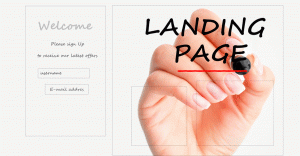
In order to make the visitors buy something from the services and products that you put on display, make your landing pages attractive. Landing pages are the first page visitors enter in your website once they have clicked on your search engine ad. This applies to those websites, too, which do not sell tangible products through their search engine marketing tricks. Even if you wish your visitors to come and sign in to your website, the landing page should be able to give the message across to them.
Don’t Lead Your Target Audience to the Sales Pages Directly
Many websites commit the mistake of taking their visitors directly to the home page. This is not a healthy sign for lead generation. The reason is that in most commercial websites, visitor who might enter some other page and not the sale page and move out without actually doing anything useful to you.
Do Make Your Landing Page Simple
One important factor about landing pages is that, they need to be simple and talking only about what needs to be done in the website. Try not to incorporate too many clicks in the landing page that will repel the user and force him to opt out of it.
Don’t Lose Your Focus
The landing pages on the other hand are more extremely to the point in its approach. The best part about the landing pages is that they need not be a part of your website. They could just be connecting page that will execute the action from the visitor and lead him to the website once he is through with his action. May it be a sign-up, a purchase or a membership, make sure he leaves your page having done something for you.
Do Generate Trust from Target Audience
Your website landing page should be able to exude “trust”. It should be convincing and trust worthy enough to attract users to perform the target action. It should not only display the product or service, but should also add information and knowledge to your user, in order to accomplish your search engine marketing campaign.
Many website owners do not realize the potential of a good landing page in search engine. The simple way of increasing ROI from your search engine marketing campaign is to persuade your visitor to generate a lead through an attractive, compelling and smart landing page.